001Notes
Cache Lines Before Big-O: Optimizing Search Algorithms by Changing Memory Access
On this page71
A single-system benchmark study of arrays, pointer chasing, binary search layouts, hash maps, prefetching, memory-level parallelism, and false sharing.
Article details
- Status
- Benchmark Backed Draft
- Subcategory
- Cache/Search Benchmarks
- Last reviewed
- 26 Aug 2026
71 sections
0. Abstract
Search performance is memory-pattern performance.1. Research Questions
| ID | Question |
|---|---|
| RQ1 | When does memory locality dominate comparison count? |
| RQ2 | Which code shapes reduce cache-line, TLB, branch, or dependency cost? |
| RQ3 | When does memory-level parallelism compensate for poor locality? |
| RQ4 | Which optimizations move cost from lookup to build, mutation, or memory footprint? |
| RQ5 | Which claims are measured, which are partial, and which remain blocked by tooling? |
2. Measurement Method
| Rule | Purpose |
|---|---|
| Fixed seed data | Repeatable input generation. |
| Correctness before timing | Invalid variants do not support timing claims. |
| Warmup before timing | Reduce first-touch effects. |
| Median of repetitions | Reduce one-run noise. |
| Printed checksum | Prevent dead-code elimination. |
| Scalar C++20 only | Keep this version free of SIMD and assembly effects. |
| Standalone binaries | Keep construction, lookup, mutation, and scaling behavior visible. |
Representative perf stat rows | Add counter evidence where available. |
3. Measured System And Boundaries
| Field | Value |
|---|---|
| System class | single measured x86_64 Linux system |
| CPU | Intel(R) Core(TM) i7-4702MQ CPU @ 2.20GHz |
| Topology | 4 cores, 8 logical CPUs |
| Cache line | 64 bytes |
| Page size | 4096 bytes |
| Compiler | g++ 13.3.0 |
| Build flags | -O3 -march=native -std=c++20 -Wall -Wextra -Wshadow -Wconversion |
| Pinning | single-thread rows pinned to one CPU; multithread rows pinned to the available CPU set |
| SMT | enabled |
| Frequency | not fixed; governor remained powersave |
| Counter tooling | representative Linux perf stat rows available; perf c2c unavailable |
4. ASCII Legend
[CL] = one 64-byte cache line
*    = useful value read
.    = fetched but unused value
P    = explicit prefetch target
?    = unpredictable address
!    = conflict, contention, or ownership risk
-> = access ordergood search path:
CPU -> [CL0: * * * * * * * *] -> [CL1: * * * * * * * *]
many useful values per fetched line
bad search path:
CPU -> [CL0: * . . . . . . .] -> [CL97: * . . . . . . .]
one useful value per fetched line
dependent search path:
CPU -> [? node] -> [? node] -> [? node]
next address is unknown until the current load returns5. Raw Memory Code Shapes
What does the CPU pay for when the operation is only "read memory"?5.1 Linear Scan
Code Shape
std::uint64_t sum = 0;

for (std::size_t i = 0; i < values.size(); ++i) {
    sum += static_cast<std::uint64_t>(values[i]);
}

return sum;
Cache-Line Access Visual
int32 payload, 16 values per 64B line:

CPU -> [CL0: * * * * * * * * * * * * * * * *]
       [CL1: * * * * * * * * * * * * * * * *]

reference point:
nearly every fetched slot is useful
Interpretation
| Field | Notes |
|---|---|
| Expectation | Sequential scan should be the best raw-memory baseline because addresses are predictable and cache-line payload is fully used. |
| Measured result | n = 1,000,000, 5 repetitions: detailed rows below. |
| What happened | Wider records cost more per logical element because each element consumes more cache-line payload. |
| Takeaway | Keep hot scan fields narrow. Do not drag cold payload through a search loop. |
| Evidence status | Supported by timing. |
Detailed rows
| Variant | Element size | ns/element | Visual |
|---|---|---|---|
int32_t | 4 B | 0.743 | # |
int64_t | 8 B | 1.027 | ## |
struct16 | 16 B | 2.808 | ##### |
struct64 | 64 B | 10.170 | #################### |
5.2 Stride Scan
Code Shape
std::uint64_t sum = 0;

for (std::size_t i = 0; i < values.size(); i += stride) {
    sum += static_cast<std::uint64_t>(values[i]);
}

return sum;
Cache-Line Access Visual
stride = 16 over int32:

CPU -> [CL0: * . . . . . . . . . . . . . . .]
       [CL1: * . . . . . . . . . . . . . . .]

reference point:
access is predictable, but most fetched bytes are unused
Interpretation
| Field | Notes |
|---|---|
| Expectation | Large strides should be slower than stride 1 because each cache line contributes fewer useful values. Power-of-two strides may also create cache-set pressure. |
| Measured result | Selected rows, n = 1,000,000, 5 repetitions: detailed rows below. |
| What happened | Stride 1 was fastest. Several plus-one strides beat nearby power-of-two strides. |
| Takeaway | Do not only ask whether the working set fits in cache. Also ask whether the addresses map evenly across cache sets. |
| Evidence status | Supported by timing. |
Detailed rows
| Stride | ns/access | Visual |
|---|---|---|
1 | 0.686 | # |
16 | 6.352 | ######### |
64 | 7.921 | ############ |
65 | 7.430 | ########### |
256 | 7.292 | ########### |
257 | 5.000 | ####### |
1024 | 7.586 | ########### |
1025 | 3.784 | ###### |
5.3 Random Access
Code Shape
std::uint64_t sum = 0;

for (std::size_t i = 0; i < indexes.size(); ++i) {
    sum += static_cast<std::uint64_t>(values[indexes[i]]);
}

return sum;
Cache-Line Access Visual
index stream:
17 -> 900231 -> 42 -> 700001

CPU -> [? CL17:  * . . . . . . .]
       [? CL900: * . . . . . . .]
       [? CL42:  * . . . . . . .]

reference point:
loads are independent, but the next line is hard to predict
Interpretation
| Field | Notes |
|---|---|
| Expectation | Random access should be tolerable for small windows and expensive when the working set exceeds cache. |
| Measured result | n = 1,000,000, queries = 1,000,000, 5 repetitions: detailed rows below. |
| What happened | The small-window row was much cheaper than full-array random access. |
| Takeaway | Constraining randomness into a smaller active window can be a real optimization. |
| Evidence status | Supported by timing. |
Detailed rows
| Pattern | ns/access | Visual |
|---|---|---|
| random small window | 4.355 | #### |
| random within page | 10.172 | ########## |
| shuffled permutation | 11.144 | ########### |
| uniform random | 12.394 | ############ |
5.4 Pointer Chase
Code Shape
std::uint64_t sum = 0;

for (PtrNode* node = head; node != nullptr; node = node->next) {
    sum += node->value;
}

return sum;
Cache-Line Access Visual
sequential arena:
CPU -> [CL0: node0 node1 node2 node3] -> [CL1: node4 node5 ...]

random heap or random arena:
CPU -> [? node A] -> [? node Q] -> [? node D] -> null

reference point:
next address is stored in the current node
Interpretation
| Field | Notes |
|---|---|
| Expectation | Arena allocation should help, but random traversal should remain expensive because each next address depends on the previous load. |
| Measured result | n = 500,000, 5 repetitions: detailed rows below. |
| What happened | Arena allocation helped, but traversal order mattered more. Random arena traversal was still much slower than sequential arena traversal. |
| Takeaway | Contiguous storage is not enough. Traversal order controls whether cache-line locality is usable. |
| Evidence status | Supported by timing. |
Detailed rows
| Variant | ns/node | Relative |
|---|---|---|
| arena sequential | 5.845 | 1.0x |
| heap sequential | 9.294 | 1.6x |
| arena randomized | 112.305 | 19.2x |
| heap randomized | 150.632 | 25.8x |
5.5 Dependent Pointer Chase
Code Shape
std::size_t index = 0;
std::uint64_t sum = 0;

for (std::size_t step = 0; step < steps; ++step) {
    index = next[index];
    sum += index;
}

return sum;
Cache-Line Access Visual
idx0 -> next[idx0] = idx1
        idx1 -> next[idx1] = idx2
                idx2 -> next[idx2] = idx3

CPU -> [? CL idx0] -> [? CL idx1] -> [? CL idx2]

reference point:
the next load cannot be issued until the current load returns
Interpretation
| Field | Notes |
|---|---|
| Expectation | Random dependent chains should expose load-to-use latency and scale poorly with working-set size. |
| Measured result | n = 1,000,000, steps = 5,000,000, 5 repetitions: detailed rows below. |
| What happened | Random and page-spread cycles were about 14x slower than the sequential cycle. |
| Takeaway | Dependent memory chains are a latency problem, not just a cache-capacity problem. |
| Evidence status | Supported by timing. |
Detailed rows
| Variant | ns/step | Relative |
|---|---|---|
| sequential cycle | 6.674 | 1.0x |
| random permutation cycle | 92.513 | 13.9x |
| page-spread cycle | 96.173 | 14.4x |
5.6 Prefetch Pointer Chase
Code Shape
std::uint64_t sum = 0;

for (PtrNode* node = head; node != nullptr; node = node->next) {
    if (node->next != nullptr) {
        prefetchRead(node->next);
    }

    sum += node->value;
}

return sum;
Cache-Line Access Visual
CPU reads [CL?: node A | next -> node B]
  P -> [CL?: node B]
CPU then uses node B soon after

reference point:
prefetch is often too late because node B is discovered at node A
Interpretation
| Field | Notes |
|---|---|
| Expectation | Simple next-prefetch may not help pointer chasing because address discovery and use are too close together. |
| Measured result | n = 500,000, 5 repetitions: detailed rows below. |
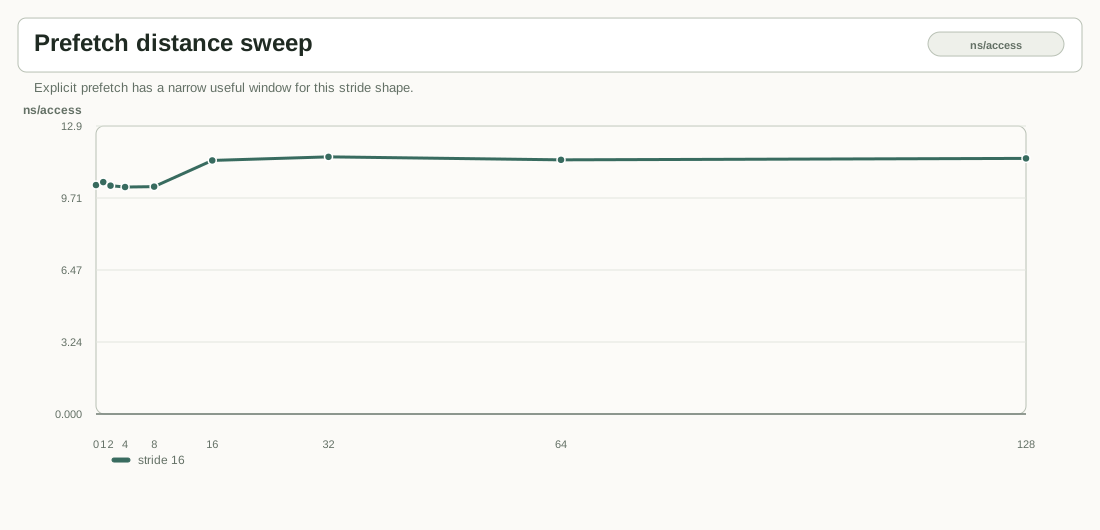
| What happened | Pointer next-prefetch did not improve the measured rows. Longer stride prefetch distances also did not improve this pass. |
| Takeaway | Prefetch is a distance problem. It helps only when the future address is known early enough and the prefetched data is likely to be used. |
| Evidence status | Supported for these rows; broader prefetch policy remains workload-specific. |
Detailed rows
| Variant | ns/node |
|---|---|
| no prefetch | 97.438 |
| prefetch next | 100.348 |
| prefetch next-next | 134.773 |
| Distance | ns/access | Visual |
|---|---|---|
| 0 | 10.293 | ################## |
| 1 | 10.426 | ################## |
| 2 | 10.265 | ################## |
| 4 | 10.204 | ################## |
| 8 | 10.221 | ################## |
| 16 | 11.400 | #################### |
| 32 | 11.560 | #################### |
| 64 | 11.427 | #################### |
| 128 | 11.491 | #################### |
5.7 MLP Pointer Chase
Code Shape
std::vector<std::size_t> index(lanes, 0);
std::uint64_t sum = 0;

for (std::size_t step = 0; step < steps; ++step) {
    for (int lane = 0; lane < lanes; ++lane) {
        index[lane] = chains[lane][index[lane]];
        sum += index[lane];
    }
}

return sum;
Cache-Line Access Visual
lane 0: CPU -> [? CL] -> [? CL] -> [? CL]
lane 1: CPU -> [? CL] -> [? CL] -> [? CL]
lane 2: CPU -> [? CL] -> [? CL] -> [? CL]
lane 3: CPU -> [? CL] -> [? CL] -> [? CL]

reference point:
each lane is dependent, but lanes are independent of each other
Interpretation
| Field | Notes |
|---|---|
| Expectation | Multiple independent chains should expose memory-level parallelism and lower per-chain cost until the core or memory system saturates. |
| Measured result | working_set = 8,000,000 bytes, steps = 1,000,000, 5 repetitions: detailed rows below. |
| What happened | Per-chain time dropped from 107.056 ns to about 17 ns near 16 lanes. |
| Takeaway | Independent work can hide latency even when each individual chain has poor locality. |
| Evidence status | Supported by timing. |
Detailed rows
| Lanes | ns/outer step | ns/chain-step | Visual per chain |
|---|---|---|---|
1 | 107.056 | 107.056 | #################### |
2 | 108.373 | 54.186 | ########## |
4 | 114.800 | 28.700 | ##### |
8 | 152.170 | 19.021 | #### |
16 | 274.044 | 17.128 | ### |
32 | 557.560 | 17.424 | ### |
5.8 Associativity Conflict
Code Shape
for (std::size_t i = 0; i < values.size(); i += stride) {
    sum += values[i];
}
Cache-Line Access Visual
stride 256:
CPU -> [CL set A: *] -> [CL set A: *] -> [CL set A: *]
                         !

stride 257:
CPU -> [CL set A: *] -> [CL set B: *] -> [CL set C: *]

reference point:
similar strides can map differently across cache sets
Interpretation
| Field | Notes |
|---|---|
| Expectation | Power-of-two strides can concentrate accesses into fewer cache sets; plus-one variants may spread mapping differently. |
| Measured result | n = 4,000,000, 5 repetitions: detailed rows below. |
| What happened | The plus-one stride was faster in every paired row in this pass. |
| Takeaway | Cache-set placement belongs in the experiment matrix. Similar-looking access patterns can differ. |
| Evidence status | Supported by timing; counter evidence not included. |
Detailed rows
| Stride | ns/access | Compared row | Visual |
|---|---|---|---|
64 | 7.862 | power of two | ############ |
65 | 7.040 | plus one | ########### |
128 | 7.970 | power of two | ############ |
129 | 7.288 | plus one | ########### |
256 | 8.441 | power of two | ############# |
257 | 7.434 | plus one | ########### |
512 | 7.507 | power of two | ########### |
513 | 6.371 | plus one | ########## |
1024 | 7.595 | power of two | ########### |
1025 | 4.920 | plus one | ####### |
5.9 TLB Page Walk
Code Shape
for (std::size_t page : page_order) {
    sum += values[(page * page_size) / sizeof(values[0])];
}
Cache-Line Access Visual
one access per page:

CPU -> [page 0: CL0: * . . . . . . .]
       [page 1: CL0: * . . . . . . .]
       [page 2: CL0: * . . . . . . .]

reference point:
one useful load per page stresses address translation
Interpretation
| Field | Notes |
|---|---|
| Expectation | Page-walk patterns should be much slower than dense sequential scans because they use fewer values per page and per cache line. |
| Measured result | n = 4,000,000, 3906 pages, 5 repetitions: detailed rows below. |
| What happened | The page-walk rows were much slower than dense sequential scan. |
| Takeaway | Good search layout should reuse both cache lines and pages. |
| Evidence status | Supported by timing; direct TLB counter rows are not shown per variant. |
Detailed rows
| Pattern | ns/access |
|---|---|
| dense sequential scan | 4.410 |
| sequential page walk | 31.813 |
| one access per 4 KB page | 32.018 |
| random page walk | 32.817 |
| Pattern | ns/access | Visual |
|---|---|---|
| one access per 4 KB page | 33.580 | ################## |
| sequential page walk | 33.277 | ################## |
| random page walk | 36.540 | #################### |
| dense sequential scan | 4.390 | ## |
5.10 Working-Set Ladder
Code Shape
for (std::size_t footprint : footprints) {
    buildInput(footprint);
    runSameAccessShape();
}
Cache-Line Access Visual
32 KiB  -> likely cache-resident
256 KiB -> larger private-cache pressure
1 MiB   -> beyond small private caches
8 MiB   -> shared-cache and memory pressure
64 MiB  -> memory-system pressure

reference point:
same loop shape, larger footprint
Interpretation
| Field | Notes |
|---|---|
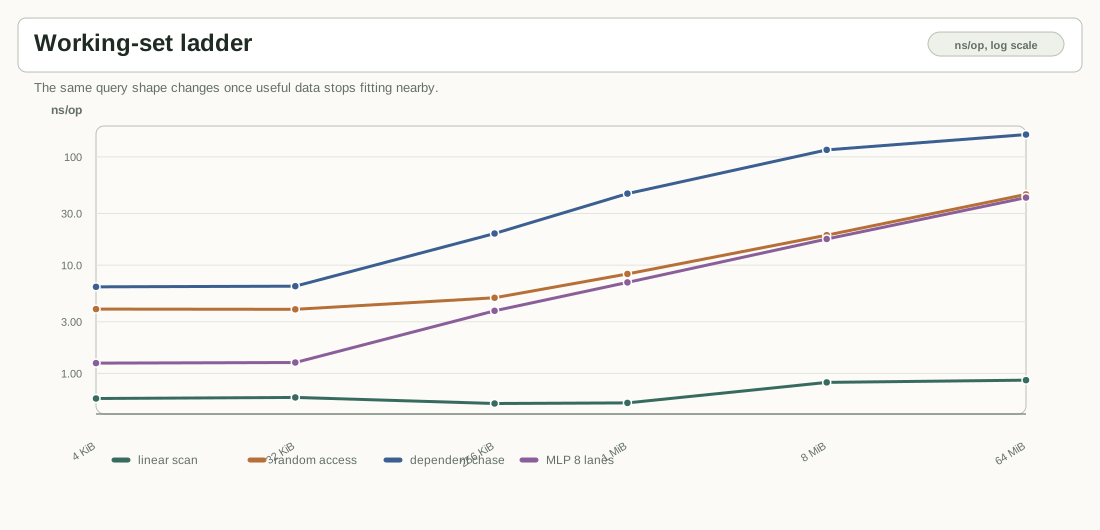
| Expectation | Sequential access should stay relatively stable; random and dependent access should rise sharply with footprint. |
| Measured result | Detailed rows below; benchmark numbers unchanged. |
| What happened | Sequential access stayed cheap. Random, pointer, and dependent rows rose sharply at larger footprints. MLP stayed lower than a single random dependent chain. |
| Takeaway | Footprint sweeps are required before interpreting one benchmark row. |
| Evidence status | Supported by timing. |
Detailed rows
| Pattern | Variant | 32 KiB ns/op | 256 KiB ns/op | 1 MiB ns/op | 8 MiB ns/op | 64 MiB ns/op |
|---|---|---|---|---|---|---|
| linear scan | int32 sequential | 0.600 | 0.527 | 0.534 | 0.827 | 0.867 |
| stride scan | stride 16 | 2.201 | 4.948 | 6.114 | 9.258 | 10.034 |
| random access | uniform random | 3.911 | 5.000 | 8.298 | 18.924 | 45.038 |
| pointer chase | arena random | 9.365 | 29.733 | 53.748 | 109.177 | 170.508 |
| dependent chase | random cycle | 6.396 | 19.608 | 45.818 | 116.110 | 160.778 |
| prefetch chase | prefetch next | 9.847 | 24.481 | 50.856 | 103.324 | 187.059 |
| MLP chase | 8 lanes | 1.261 | 3.788 | 6.932 | 17.450 | 42.083 |
| TLB page walk | random page | 19.375 | 7.828 | 7.070 | 28.464 | 38.044 |
5.11 Cold/Warm Scan, Write Traffic, And Huge Pages
Code Shape
touchEvictionBuffer();
runScan();      // cold-style pass
runScan();      // warm repeated pass

for (std::size_t i = 0; i < values.size(); ++i) {
    values[i] = values[i] + 1;
}
Cache-Line Access Visual
cold-style:
CPU -> [eviction buffer] -> [CL0: * * * *] -> [CL1: * * * *]

read-modify-write:
CPU -> [CL0: load * * * *] -> [CL0: writable !] -> store

transparent huge-page probe:
4 KiB pages -> many translations
2 MiB pages -> fewer translations, if available
Interpretation
| Field | Notes |
|---|---|
| Expectation | Warm repeated scans may be faster. Writes should cost more than reads because cache lines must become writable. Huge pages may help TLB-sensitive access if available. |
| Measured result | Cold versus warm, 32 MiB: detailed rows below. |
| What happened | The warm scan was only slightly faster. Writes were slower than reads. Transparent huge pages were slightly faster in this row, while explicit huge pages were unavailable. |
| Takeaway | Read/write ownership and page size are real variables, but this article has timing evidence only, not direct RFO or per-row TLB counter proof. |
| Evidence status | Partially supported. Explicit huge pages and direct RFO counters remain blocked or unavailable. |
Detailed rows
| Items | Bytes | Cold ns/elt | Warm ns/elt | Cold/Warm | Visual |
|---|---|---|---|---|---|
| 8,388,608 | 32 MiB | 0.886 | 0.865 | 1.02x | ## |
| Variant | ns/op | Visual |
|---|---|---|
| read_only | 1.273 | ############# |
| write_stream | 1.918 | #################### |
| read_modify_write | 1.884 | ################### |
| Mode | Status | Page size | ns/value | Note |
|---|---|---|---|---|
| default pages | measured | 4096 | 1.289 | normal anonymous mapping |
| explicit huge pages | unavailable | 2097152 | n/a | huge-page allocation unavailable |
| transparent huge pages | measured | 2097152 | 1.253 | advised huge-page path |
6. Linked-List Code Shapes
Can list-like search be made less expensive by changing
how much useful work each pointer jump buys?
6.1 Heap List
Code Shape
bool searchList(PtrNode* head, int key) {
    for (PtrNode* node = head; node != nullptr; node = node->next) {
        if (node->value == key) {
            return true;
        }
    }

    return false;
}
Cache-Line Access Visual
CPU -> [? heap node A: * next] -> [? heap node Q: * next]
       -> [? heap node D: * next] -> null

reference point:
one useful value per dependent pointer jump
Interpretation
| Field | Notes |
|---|---|
| Expectation | Heap allocation should be the poor-locality baseline when traversal order is scattered. |
| Measured result | Pointer-chase row: detailed rows below. |
| What happened | Heap randomized traversal was the expensive baseline. |
| Takeaway | Heap nodes plus random traversal are a worst-case shape for cache-line reuse. |
| Evidence status | Supported by timing. |
Detailed rows
| Variant | ns/node | Relative |
|---|---|---|
| heap sequential | 9.294 | 1.6x |
| heap randomized | 150.632 | 25.8x |
| Variant | ns/query | Relative |
|---|---|---|
| heap randomized | 3,646,397 | 28.1x |
6.2 Arena List
Code Shape
std::vector<PtrNode> nodes(n);

for (std::size_t i = 0; i + 1U < nodes.size(); ++i) {
    nodes[i].value = static_cast<std::uint64_t>(i);
    nodes[i].next = &nodes[i + 1U];
}

nodes.back().next = nullptr;
Cache-Line Access Visual
arena memory:
[CL0: node0 node1 node2 node3] [CL1: node4 node5 node6 node7]

CPU -> node0 -> node1 -> node2 -> node3 -> node4

reference point:
allocation and traversal are both compact
Interpretation
| Field | Notes |
|---|---|
| Expectation | Arena allocation should improve locality but cannot remove the pointer dependency. |
| Measured result | Detailed rows below; benchmark numbers unchanged. |
| What happened | Arena sequential was much faster than heap randomized, but slower than chunked list search in the compare-all row. |
| Takeaway | Arena allocation helps, but one pointer jump per value is still expensive for late-hit and miss-heavy search. |
| Evidence status | Supported by timing. |
Detailed rows
| Variant | ns/node | Relative |
|---|---|---|
| arena sequential | 5.845 | 1.0x |
| Variant | ns/query | Relative |
|---|---|---|
| arena sequential | 333,708 | 2.6x |
6.3 Random Arena List
Code Shape
std::vector<std::size_t> order = makeRandomPermutation(n, seed);

for (std::size_t i = 0; i + 1U < order.size(); ++i) {
    nodes[order[i]].next = &nodes[order[i + 1U]];
}

nodes[order.back()].next = nullptr;
Cache-Line Access Visual
arena memory:
[CL0: node0 node1 node2 node3] [CL1: node4 node5 node6 node7]

CPU -> node3 -> node0 -> node7 -> node2 -> node5

reference point:
storage is compact, but traversal is not
Interpretation
| Field | Notes |
|---|---|
| Expectation | Random traversal should be slow even when allocation is compact. |
| Measured result | Detailed rows below; benchmark numbers unchanged. |
| What happened | Random arena traversal was much slower than arena sequential traversal. |
| Takeaway | The CPU follows access order, not allocation intent. |
| Evidence status | Supported by timing. |
Detailed rows
| Variant | ns/node | Relative |
|---|---|---|
| arena randomized | 112.305 | 19.2x |
6.4 Prefetch List
Code Shape
for (PtrNode* node = head; node != nullptr; node = node->next) {
    if (node->next != nullptr) {
        prefetchRead(node->next);
    }

    sum += node->value;
}
Cache-Line Access Visual
CPU reads [CL?: node A | next -> node B]
  P -> [CL?: node B]
CPU immediately advances to node B

reference point:
prefetch target is discovered late
Interpretation
| Field | Notes |
|---|---|
| Expectation | Naive pointer-list prefetch should be weak because there is little work between prefetch and use. |
| Measured result | Detailed rows below; benchmark numbers unchanged. |
| What happened | Naive prefetch did not beat arena sequential in these rows. |
| Takeaway | Linked-list prefetch needs enough independent work between address discovery and use. |
| Evidence status | Supported for this implementation and query mix. |
Detailed rows
| Variant | ns/query | Relative |
|---|---|---|
| prefetch next on arena list | 484,095 | 3.7x |
| arena sequential | 333,708 | 2.6x |
| Variant | ns/query | Visual |
|---|---|---|
| prefetch next | 963,053 | ## |
| arena sequential | 667,221 | # |
6.5 Chunked List
Code Shape
template <int ChunkSize>
bool searchChunked(const ChunkNode<ChunkSize>* head, int key) {
    for (auto* node = head; node != nullptr; node = node->next) {
        for (int i = 0; i < node->count; ++i) {
            if (node->values[i] == key) {
                return true;
            }
        }
    }

    return false;
}
Cache-Line Access Visual
normal list:
CPU -> [CL?: value next] -> [CL?: value next] -> [CL?: value next]

chunked list:
CPU -> [CL0: * * * * * * * * | chunk metadata]
       [CL1: * * * * * * * * | next part of chunk]
       -> next chunk

reference point:
one pointer jump buys many value checks
Interpretation
| Field | Notes |
|---|---|
| Expectation | Chunking should improve late-hit and miss-heavy list search because it reduces pointer jumps per searchable value. |
| Measured result | Compare-all: detailed rows below. |
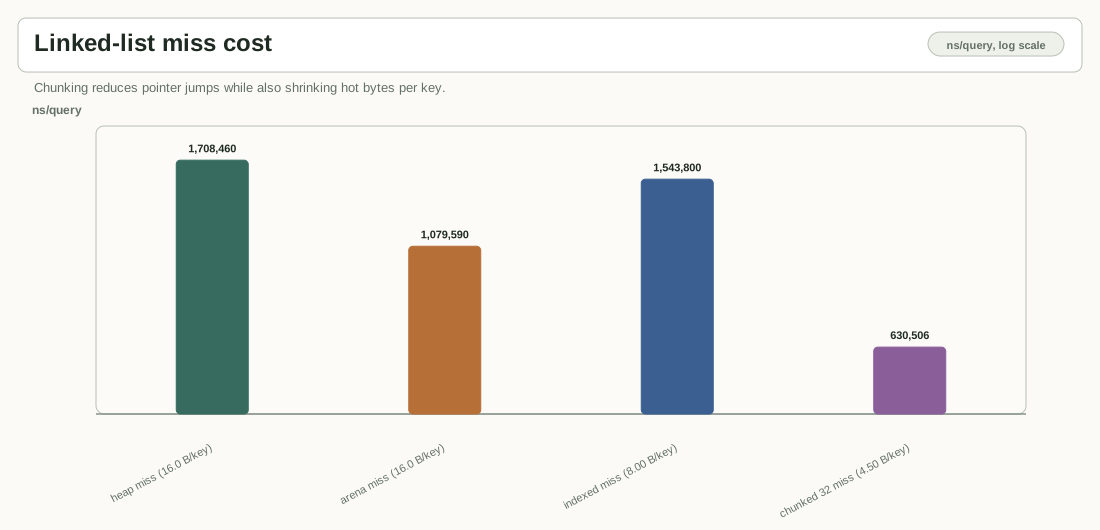
| What happened | Chunking improved the expensive late-hit and miss rows compared with pointer-per-value traversal. |
| Takeaway | If a list must be scanned, make each pointer jump buy a block of local work. |
| Evidence status | Supported by timing. |
Detailed rows
| Variant | ns/query | Relative |
|---|---|---|
| chunked 64 | 129,629 | 1.0x |
| arena sequential | 333,708 | 2.6x |
| heap randomized | 3,646,397 | 28.1x |
| Position | Ops | ns/query | Visual |
|---|---|---|---|
| early hit | 1,000,000 | 5.68 | # |
| middle hit | 500 | 315,212 | ########## |
| late hit | 500 | 633,347 | #################### |
| miss | 500 | 630,506 | #################### |
6.6 Chunked Prefetch
Code Shape
template <int ChunkSize>
bool searchChunkedPrefetch(const ChunkNode<ChunkSize>* head, int key) {
    for (auto* node = head; node != nullptr; node = node->next) {
        if (node->next != nullptr) {
            prefetchRead(node->next);
        }

        for (int i = 0; i < node->count; ++i) {
            if (node->values[i] == key) {
                return true;
            }
        }
    }

    return false;
}
Cache-Line Access Visual
CPU reads [chunk A | next -> chunk B]
  P -> [chunk B]
CPU scans [CL A0: * * * *] [CL A1: * * * *]
CPU then uses [chunk B]

reference point:
chunk scan creates prefetch distance
Interpretation
| Field | Notes |
|---|---|
| Expectation | Chunked prefetch should help more than normal list prefetch because scanning the current chunk creates lead time. |
| Measured result | n = 100,000, queries = 5,000, 5 repetitions: detailed rows below. |
| What happened | Prefetch was not a broad win. The best no-prefetch and prefetch rows were both chunk size 16. |
| Takeaway | Prefetch distance is necessary but not sufficient. Chunk size, query mix, and cache state decide whether it pays. |
| Evidence status | Mixed timing evidence. |
Detailed rows
| Chunk size | no prefetch ns/query | prefetch ns/query |
|---|---|---|
4 | 149,268 | 165,376 |
8 | 98,464 | 108,059 |
16 | 94,233 | 98,170 |
32 | 183,450 | 228,932 |
64 | 189,332 | 187,497 |
128 | 101,391 | 105,723 |
256 | 134,423 | 133,957 |
6.7 Indexed List
Code Shape
struct IndexNode {
    int value = 0;
    int next = -1;
};

bool searchIndexed(const std::vector<IndexNode>& nodes, int key) {
    for (int index = 0; index != -1; index = nodes[static_cast<std::size_t>(index)].next) {
        if (nodes[static_cast<std::size_t>(index)].value == key) {
            return true;
        }
    }

    return false;
}
Cache-Line Access Visual
nodes vector:
[CL0: idx0 value,next | idx1 value,next | idx2 value,next | idx3 value,next]

CPU -> nodes[0] -> nodes[4] -> nodes[1]

reference point:
link is a compact integer, but traversal is still dependent
Interpretation
| Field | Notes |
|---|---|
| Expectation | Indexed nodes should reduce hot-node footprint, but still behave like a dependent chase. |
| Measured result | n = 200,000, queries = 500, 3 repetitions: detailed rows below. |
| What happened | Indexed nodes cut footprint but were slower than arena pointer nodes in the listed high-level query shape. |
| Takeaway | Compact representation helps memory footprint, but it does not remove address dependency. |
| Evidence status | Supported by timing and byte counts. |
Detailed rows
| Variant | ns/query | Bytes/searchable key |
|---|---|---|
| indexed list | 949,784 | 8.0 |
| Position | Ops | ns/query | Visual |
|---|---|---|---|
| early hit | 1,000,000 | 2.56 | # |
| middle hit | 500 | 771,964 | ########## |
| late hit | 500 | 1,545,820 | #################### |
| miss | 500 | 1,543,800 | #################### |
6.8 Hot/Cold List
Code Shape
struct HotNode {
    int key = 0;
    int next = -1;
};

struct ColdNode {
    int value = 0;
    std::array<char, PayloadSize> payload{};
};

bool searchHot(const std::vector<HotNode>& hot, int key) {
    for (int index = 0; index != -1; index = hot[static_cast<std::size_t>(index)].next) {
        if (hot[static_cast<std::size_t>(index)].key == key) {
            return true;
        }
    }

    return false;
}
Cache-Line Access Visual
fat node search:
CPU -> [CL: key next payload payload] -> [CL: payload payload ...]

hot/cold search:
CPU -> [CL hot: key next | key next | key next | key next]
only on match -> [cold payload]

reference point:
negative search touches metadata, not payload
Interpretation
| Field | Notes |
|---|---|
| Expectation | Hot/cold split should help as payload grows. |
| Measured result | n = 100,000, queries = 5,000, 5 repetitions: detailed rows below. |
| What happened | Fat-node search cost grew with payload. Hot/cold search stayed nearly flat. |
| Takeaway | Search should touch searchable metadata first and cold payload only after a match. |
| Evidence status | Supported by timing. |
Detailed rows
| Payload | fat node ns/query | hot/cold ns/query | Improvement |
|---|---|---|---|
16 B | 827,299 | 559,820 | 1.5x |
64 B | 1,504,184 | 559,620 | 2.7x |
128 B | 2,615,491 | 559,849 | 4.7x |
256 B | 4,265,747 | 559,886 | 7.6x |
6.9 Multi-Lane List
Code Shape
std::uint64_t found = 0;

for (std::size_t q = 0; q < queries.size(); q += static_cast<std::size_t>(lanes)) {
    for (int lane = 0; lane < lanes; ++lane) {
        found += searchList(heads[static_cast<std::size_t>(lane)], queries[q + lane]);
    }
}
Cache-Line Access Visual
lane 0: CPU -> [? node] -> [? node] -> [? node]
lane 1: CPU -> [? node] -> [? node] -> [? node]
lane 2: CPU -> [? node] -> [? node] -> [? node]
lane 3: CPU -> [? node] -> [? node] -> [? node]

reference point:
one list remains dependent; many lists expose throughput parallelism
Interpretation
| Field | Notes |
|---|---|
| Expectation | Interleaving independent searches should expose memory-level parallelism. |
| Measured result | n = 200,000, queries = 250, 3 repetitions: detailed rows below. |
| What happened | Per-query time dropped sharply as lanes increased. |
| Takeaway | MLP improves throughput across independent list searches, not the latency of one dependent traversal. |
| Evidence status | Supported by timing. |
Detailed rows
| Lanes | ns/query | Visual |
|---|---|---|
1 | 7,129,608 | #################### |
2 | 3,419,579 | ########## |
4 | 1,604,336 | ##### |
8 | 611,275 | ## |
16 | 250,894 | # |
6.10 Bloom Chunked List
Code Shape
bool searchBloomChunked(const BloomChunkNode<ChunkSize>* head, int key) {
    for (auto* node = head; node != nullptr; node = node->next) {
        if ((node->bloom & bloomMask(key)) == 0U) {
            continue;
        }

        for (int i = 0; i < node->count; ++i) {
            if (node->values[i] == key) {
                return true;
            }
        }
    }

    return false;
}
Cache-Line Access Visual
negative lookup:
CPU -> [CL chunk metadata: bloom bits]
       bit absent -> skip [values] -> next chunk

maybe hit:
CPU -> [CL chunk metadata: bloom bits]
       bit present -> [CL values: * * * *]

reference point:
cheap metadata can avoid scanning values
Interpretation
| Field | Notes |
|---|---|
| Expectation | Bloom filtering should help negative lookups by skipping local chunk scans. |
| Measured result | n = 200,000, queries = 2,000, 3 repetitions: detailed rows below. |
| What happened | The hit-ratio sweep improved as generated hits became more common and early in the benchmark shape. |
| Takeaway | Bloom-per-chunk needs hit-ratio and hit-position separated before making a broad claim. |
| Evidence status | Partially supported. |
Detailed rows
| Hit ratio | ns/query | Visual |
|---|---|---|
0% | 314,063 | #################### |
10% | 282,604 | ################## |
50% | 157,390 | ########## |
100% | 1,543 | # |
6.11 Compare-All And Mutation Rows
Code Shape
sameQueries();
run(heapList);
run(arenaList);
run(prefetchList);
run(chunkedList);

// mutation timing is separated from search-to-position cost
insertAfter(cursor);
deleteAfter(cursor);
spliceAfter(source, dest);
Cache-Line Access Visual
compare-all:
same query stream -> heap / arena / prefetch / chunked

mutation:
[cursor] -> [new_node] -> [old_next]
[cursor] -----------> [next_after_delete]

reference point:
lookup-friendly layout may move cost to update paths
Interpretation
| Field | Notes |
|---|---|
| Expectation | Chunking should win lookup-heavy rows. Vector-backed mutation should avoid heap-allocation overhead. |
| Measured result | Completion compare-all, n = 200,000, queries = 500, 3 repetitions: detailed rows below. |
| What happened | Chunked lookup was strongest in compare-all. Heap allocation was expensive in mutation. Indexed mutation rows were cheapest in this pass. |
| Takeaway | List layout decisions should be evaluated on both lookup and mutation paths. |
| Evidence status | Supported for measured append/insert/delete/splice shapes; arbitrary middle-position search cost is separate. |
Detailed rows
| Variant | ns/query | Visual |
|---|---|---|
| heap randomized | 11,208,462 | #################### |
| prefetch next | 963,053 | ## |
| arena sequential | 667,221 | # |
| chunked 64 | 257,240 | # |
| Layout | Operation | ns/op | Bytes/node | Visual |
|---|---|---|---|---|
| pointer arena | insert after, preallocated | 32.796 | 16 | #### |
| pointer heap | insert after, new | 177.696 | 16 | ################## |
| pointer arena | delete after unlink | 112.199 | 16 | ########### |
| pointer arena | splice after relink | 194.450 | 16 | #################### |
| indexed | insert after, preallocated | 13.728 | 8 | # |
| indexed | delete after free list | 27.253 | 8 | ### |
| indexed | splice after relink | 39.530 | 8 | #### |
7. Binary-Search Code Shapes
Can fewer global jumps beat fewer comparisons?7.1 Tiny Linear Search
Code Shape
bool linearContains(const int* values, std::size_t n, int key) {
    for (std::size_t i = 0; i < n; ++i) {
        if (values[i] == key) {
            return true;
        }
    }

    return false;
}
Cache-Line Access Visual
small array:
CPU -> [CL0: * * * * * * * * * * * * * * * *]

reference point:
for tiny arrays, the full scan can stay in one or a few cache lines
Interpretation
| Field | Notes |
|---|---|
| Expectation | Linear search should win early-hit rows for tiny arrays; binary search should win misses as n grows. |
| Measured result | queries = 1,000,000, 5 repetitions: detailed rows below. |
| What happened | Linear search won early hits. Binary search won misses once n grew. |
| Takeaway | Small local search policy depends on hit position and miss rate. |
| Evidence status | Supported by timing. |
Detailed rows
| n | linear early hit | binary early hit | linear miss | binary miss |
|---|---|---|---|---|
4 | 3.882 | 15.478 | 17.717 | 17.401 |
8 | 3.852 | 25.126 | 27.938 | 18.645 |
16 | 3.870 | 28.822 | 48.121 | 20.227 |
32 | 3.857 | 33.978 | 88.823 | 23.728 |
64 | 3.904 | 35.470 | 172.843 | 28.091 |
7.2 Normal Binary Search
Code Shape
bool binaryContains(const std::vector<int>& values, int key) {
    std::size_t left = 0;
    std::size_t right = values.size();

    while (left < right) {
        const std::size_t mid = left + (right - left) / 2U;

        if (values[mid] == key) {
            return true;
        }

        if (values[mid] < key) {
            left = mid + 1U;
        } else {
            right = mid;
        }
    }

    return false;
}
Cache-Line Access Visual
CPU -> [CL mid: * . . .]
       -> [CL quarter: * . . .]
       -> [CL eighth: * . . .]

reference point:
few comparisons, but jumpy memory access
Interpretation
| Field | Notes |
|---|---|
| Expectation | Normal binary search should be a strong comparison-count baseline but can lose to layouts with better memory locality. |
| Measured result | Large-array compare-all, n = 1,000,000, queries = 1,000,000, 5 repetitions: detailed rows below. |
| What happened | Normal binary was slower than Eytzinger and blocked layouts in the large-array rows shown here. |
| Takeaway | Minimizing comparisons does not necessarily minimize memory stalls. |
| Evidence status | Supported by timing. |
Detailed rows
| Variant | ns/query | Visual |
|---|---|---|
| normal binary | 591.551 | #################### |
| Eytzinger | 326.475 | ########### |
| Variant | ns/query | Visual |
|---|---|---|
| binary | 738.569 | ############## |
| Eytzinger | 328.340 | ###### |
7.3 Branchless Binary
Code Shape
bool branchlessContains(const std::vector<int>& values, int key) {
    std::size_t base = 0;
    std::size_t len = values.size();

    while (len > 1U) {
        const std::size_t half = len / 2U;
        const std::size_t mid = base + half;
        const bool move = values[mid] <= key;
        base = move ? mid : base;
        len -= half;
    }

    return !values.empty() && values[base] == key;
}
Cache-Line Access Visual
CPU -> [CL mid: *]
       compute move flag
       update base without branch-shaped control flow
       -> [CL next mid: *]

reference point:
branch behavior changes; memory jumps remain
Interpretation
| Field | Notes |
|---|---|
| Expectation | Branchless search should help when branch misses matter, but cannot remove jumpy memory access. |
| Measured result | Detailed rows below; benchmark numbers unchanged. |
| What happened | Branchless timing beat normal binary in the displayed compare-all row. The counter row is program-level, not per variant. |
| Takeaway | Branch behavior is material, but per-variant counter isolation is still needed. |
| Evidence status | Partially supported by timing and representative counters. |
Detailed rows
| Variant | ns/query | Visual |
|---|---|---|
| branchless | 338.353 | ########### |
| normal binary | 591.551 | #################### |
| Family | Status | Branches | Branch misses | Miss rate |
|---|---|---|---|---|
| binary search | measured with Linux perf stat | 381,401,896 | 44,259,946 | 11.60% |
7.4 Blocked Search
Code Shape
bool blockedContains(const BlockedArray& array, int key) {
    auto it = std::lower_bound(array.blockMax.begin(), array.blockMax.end(), key);
    if (it == array.blockMax.end()) {
        return false;
    }

    const int block = static_cast<int>(it - array.blockMax.begin());
    const int first = block * array.blockSize;
    const int last = std::min(first + array.blockSize, static_cast<int>(array.values.size()));

    for (int i = first; i < last; ++i) {
        if (array.values[static_cast<std::size_t>(i)] == key) {
            return true;
        }
    }

    return false;
}
Cache-Line Access Visual
metadata:
CPU -> [CL blockMax: * . . .] -> choose block

local scan:
CPU -> [CL block: * * * * * * * *]
       [CL block: * * * * * * * *]

reference point:
one global decision leads to local sequential work
Interpretation
| Field | Notes |
|---|---|
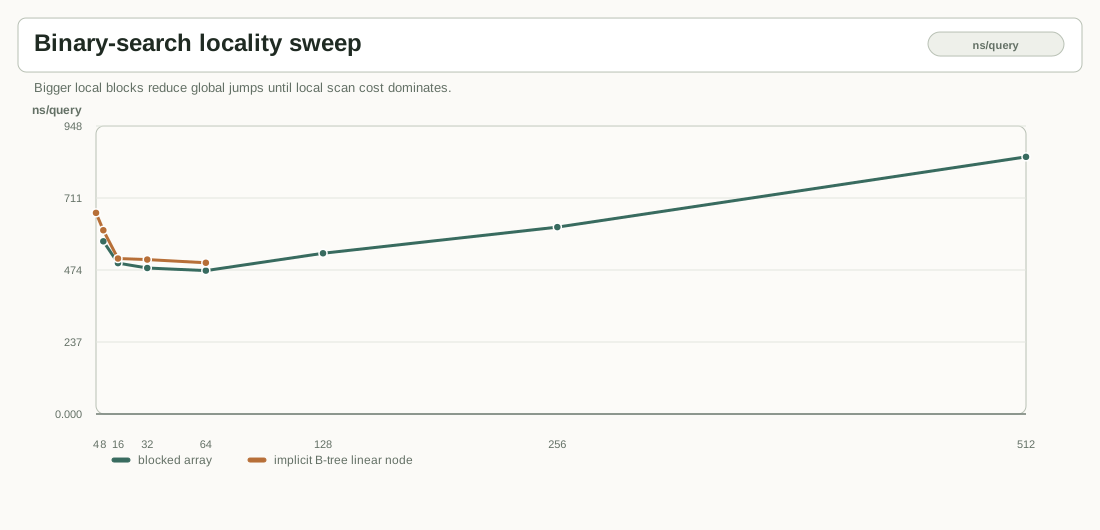
| Expectation | Blocked search should have a sweet spot: small blocks cost metadata search, large blocks cost local scanning. |
| Measured result | Block-size sweep: detailed rows below. |
| What happened | Block size 64 was best in this pass. |
| Takeaway | The correct block size is empirical. It balances global jumps against local scan work. |
| Evidence status | Supported by timing. |
Detailed rows
| Block size | ns/query | Visual |
|---|---|---|
8 | 568.714 | ############# |
16 | 496.838 | ############ |
32 | 480.809 | ########### |
64 | 472.178 | ########### |
128 | 529.335 | ############ |
256 | 615.460 | ############## |
512 | 846.829 | #################### |
7.5 Cache-Line Block Search
Code Shape
for (int blockSize : {16, 32, 64}) {
    auto index = buildBlockedArray(values, blockSize);
    runQueries(index);
}
Cache-Line Access Visual
int32 values:
block 16 -> [CL0: * * * * * * * * * * * * * * * *]
block 32 -> [CL0: * * * * ...] [CL1: * * * * ...]
block 64 -> [CL0] [CL1] [CL2] [CL3]

reference point:
test one, two, and four nearby cache lines
Interpretation
| Field | Notes |
|---|---|
| Expectation | One-cache-line blocks may be good, but larger nearby blocks can win if they reduce more global jumps. |
| Measured result | Detailed rows below; benchmark numbers unchanged. |
| What happened | The 64 value block was best in this pass. |
| Takeaway | “One cache line” is not automatically the optimal block size. |
| Evidence status | Supported by timing. |
Detailed rows
| Block size | ns/query | Visual |
|---|---|---|
16 | 499.228 | #################### |
32 | 481.549 | ################### |
64 | 471.386 | ################## |
7.6 Eytzinger Search
Code Shape
bool eytzingerContains(const std::vector<int>& eytzinger, int key) {
    std::size_t index = 1;

    while (index < eytzinger.size()) {
        if (eytzinger[index] == key) {
            return true;
        }

        index = key < eytzinger[index] ? index * 2U : index * 2U + 1U;
    }

    return false;
}
Cache-Line Access Visual
array-backed tree:

index:  1
       / \
      2   3
     / \ / \
    4  5 6  7

CPU -> [CL: eyt[1] eyt[2] eyt[3] ...] -> child index by arithmetic

reference point:
tree shape without pointer nodes
Interpretation
| Field | Notes |
|---|---|
| Expectation | Eytzinger should improve large read-only search by changing physical layout while keeping compact array storage. |
| Measured result | Large-array compare-all: detailed rows below. |
| What happened | Eytzinger was the fastest large-array row in the displayed passes. |
| Takeaway | Physical layout can matter as much as search logic. |
| Evidence status | Supported by timing. |
Detailed rows
| Variant | ns/query | Visual |
|---|---|---|
| Eytzinger | 326.475 | ########### |
| normal binary | 591.551 | #################### |
| Variant | ns/query | Visual |
|---|---|---|
| Eytzinger | 328.340 | ###### |
| binary | 738.569 | ############## |
7.7 Eytzinger Prefetch
Code Shape
if (prefetchDistance >= 1) {
    const std::size_t child = index * 2U;
    if (child < eytzinger.size()) {
        prefetchRead(&eytzinger[child]);
    }
}
Cache-Line Access Visual
CPU at eyt[i]
  P child       -> eyt[2*i]
  P grandchild  -> eyt[4*i]
CPU compares eyt[i]
CPU chooses next child

reference point:
future addresses are arithmetic, but not all prefetched paths are used
Interpretation
| Field | Notes |
|---|---|
| Expectation | Prefetch may help when distance is right and hurt when it is too near, too far, or polluting. |
| Measured result | Detailed rows below; benchmark numbers unchanged. |
| What happened | Child prefetch was worse. Grandchild prefetch was slightly faster than the no-prefetch row in this pass. |
| Takeaway | Prefetch distance is a parameter, not a feature toggle. |
| Evidence status | Partially supported by timing. |
Detailed rows
| Variant | ns/query | Visual |
|---|---|---|
| Eytzinger | 314.106 | ############# |
| prefetch child | 494.878 | #################### |
| prefetch grandchildren | 312.936 | ############# |
7.8 Implicit B-Tree
Code Shape
int childSlotLinear(const BTreeNodeShape& node, int key) {
    int slot = 0;

    while (slot < node.count && key > node.keys[static_cast<std::size_t>(slot)]) {
        ++slot;
    }

    return slot;
}
Cache-Line Access Visual
binary tree:
CPU -> [node] -> [node] -> [node] -> [node]

implicit B-tree:
CPU -> [CL node: k0 k1 k2 k3 k4 k5 k6 k7 | child offsets]
       -> child node

reference point:
more local comparisons, fewer levels
Interpretation
| Field | Notes |
|---|---|
| Expectation | Higher fanout should reduce depth, but too much inside-node search can cost more. |
| Measured result | Detailed rows below; benchmark numbers unchanged. |
| What happened | Linear inside-node scan won across tested fanouts. 64 keys was the fastest linear inside-node row. |
| Takeaway | Local sequential work can beat branchier inside-node search. |
| Evidence status | Supported by timing. |
Detailed rows
| Node keys | Linear inside-node ns/query | Binary inside-node ns/query | Faster |
|---|---|---|---|
4 | 662.335 | 735.386 | linear |
8 | 605.165 | 736.048 | linear |
16 | 511.993 | 734.992 | linear |
32 | 508.562 | 743.072 | linear |
64 | 498.007 | 739.088 | linear |
7.9 Power-Of-Two Padding
Code Shape
for (std::size_t n : {pow2, pow2 + 123U, pow2 + 257U, pow2 + 4099U}) {
    auto values = makeSortedEvenKeys(n);
    runSearchVariants(values, queries);
}
Cache-Line Access Visual
n = 2^20:
CPU -> regular midpoint offsets -> possible repeated set mapping !

n = 2^20 + 257:
CPU -> shifted midpoint offsets -> different set mapping

reference point:
same algorithm, changed address placement
Interpretation
| Field | Notes |
|---|---|
| Expectation | Power-of-two sizes can expose address-mapping sensitivity. |
| Measured result | Normal binary: detailed rows below. |
| What happened | The padded 2^20 + 257 row improved normal binary substantially. Eytzinger was less sensitive in this table. |
| Takeaway | Array size can change search speed even when the algorithm is identical. |
| Evidence status | Supported by timing; counter confirmation is missing. |
Detailed rows
| n | ns/query | Visual |
|---|---|---|
| 1,048,576 | 750.393 | ############### |
| 1,048,699 | 649.605 | ############# |
| 1,048,833 | 628.107 | ############# |
| 1,052,675 | 609.551 | ############ |
| 2,097,152 | 1,000.268 | #################### |
| 2,097,275 | 846.635 | ################# |
| n | ns/query | Visual |
|---|---|---|
| 1,048,576 | 336.239 | ############### |
| 1,048,699 | 352.473 | ############### |
| 1,048,833 | 347.754 | ############### |
| 1,052,675 | 335.315 | ############## |
| 2,097,152 | 456.035 | #################### |
| 2,097,275 | 441.157 | ################### |
7.10 Query Ordering
Code Shape
std::sort(queries.begin(), queries.end());
runSearchVariants(values, queries);
Cache-Line Access Visual
random queries:
q900 -> q17 -> q700 -> q3
CPU  -> [CL far] -> [CL far] -> [CL far]

clustered queries:
q100 -> q101 -> q104 -> q110
CPU  -> [CL region A] -> [CL region A] -> [CL nearby]

reference point:
same data structure, different temporal locality
Interpretation
| Field | Notes |
|---|---|
| Expectation | Sorted or clustered queries should reuse nearby array/tree regions. |
| Measured result | n = 1,000,000, queries = 1,000,000, 5 repetitions: detailed rows below. |
| What happened | Clustered queries made normal binary much faster than random queries. |
| Takeaway | Work ordering can be a memory optimization without changing the data structure. |
| Evidence status | Supported by timing. |
Detailed rows
| Query order | binary ns/query | Eytzinger ns/query | blocked ns/query |
|---|---|---|---|
| random | 595.078 | 328.620 | 475.115 |
| sorted | 184.750 | 207.668 | 179.653 |
| clustered | 80.564 | 171.971 | 133.153 |
| bucketed high bits | 185.036 | 207.205 | 179.505 |
7.11 Duplicate-Key And Lower-Bound Behavior
Code Shape
auto lower = std::lower_bound(values.begin(), values.end(), key);
auto upper = std::upper_bound(values.begin(), values.end(), key);
return std::make_pair(lower, upper);
Cache-Line Access Visual
membership:
CPU -> find any equal key

lower_bound:
CPU -> first key >= query

equal_range:
CPU -> lower bound path + upper bound path

reference point:
same sorted array, different query contract
Interpretation
| Field | Notes |
|---|---|
| Expectation | Membership timing should not be assumed to represent lower-bound or range queries. |
| Measured result | n = 1,048,576, queries = 1,000,000, 3 repetitions: detailed rows below. |
| What happened | Duplicate-heavy rows were faster in this benchmark shape, but range queries still have their own cost. |
| Takeaway | Define the exact search contract before comparing layouts. |
| Evidence status | Supported by timing. |
Detailed rows
| Duplicate run | binary search membership | lower-bound membership | lower-bound position | equal-range count |
|---|---|---|---|---|
1 | 729.078 | 713.280 | 726.278 | 743.355 |
4 | 715.141 | 706.743 | 707.536 | 737.183 |
16 | 700.384 | 689.846 | 686.602 | 724.461 |
64 | 644.760 | 632.632 | 636.485 | 678.741 |
8. Hash-Map Code Shapes
How much does O(1) lookup depend on collision layout and metadata placement?8.1 Chained Heap
Code Shape
struct ChainNode {
    int key;
    int value;
    ChainNode* next;
};

bool find(int key, int& out) const {
    ChainNode* node = buckets[hash(key) % bucketCount];
    while (node != nullptr) {
        if (node->key == key) {
            out = node->value;
            return true;
        }
        node = node->next;
    }
    return false;
}
Cache-Line Access Visual
CPU -> [bucket pointer]
       -> [? heap node: key value next]
       -> [? heap node: key value next]

reference point:
random bucket plus pointer chain
Interpretation
| Field | Notes |
|---|---|
| Expectation | Heap chaining should be the pointer-chasing baseline. |
| Measured result | implemented but not shown as a separate public table in this article. |
| What happened | The displayed compare-all row uses chained arena rather than chained heap. |
| Takeaway | Heap chaining needs a direct row before it can support a public timing claim here. |
| Evidence status | Implemented but not shown. |
8.2 Chained Arena
Code Shape
std::vector<ChainNode> arena;
std::vector<int> bucketHead;

int index = bucketHead[bucket];
while (index != -1) {
    const ChainNode& node = arena[static_cast<std::size_t>(index)];
    if (node.key == key) {
        return true;
    }
    index = node.nextIndex;
}
Cache-Line Access Visual
CPU -> [bucket index]
       -> [CL arena: node0 node1 node2 node3]
       -> maybe next arena index

reference point:
collision chain remains, but nodes are compact
Interpretation
| Field | Notes |
|---|---|
| Expectation | Arena chaining should beat scattered chaining and may beat open addressing if chains stay short and compact. |
| Measured result | n = 524,288, queries = 500,000, 3 repetitions: detailed rows below. |
| What happened | Chained arena was fastest in this implementation and workload. |
| Takeaway | Open addressing does not automatically win. Implementation shape and compactness matter. |
| Evidence status | Supported by timing. |
Detailed rows
| Variant | ns/query | Visual |
|---|---|---|
| chained arena | 69.551 | ########### |
| Robin Hood | 95.566 | ############## |
std::unordered_map | 100.008 | ############### |
| tag split 8 | 108.137 | ################ |
| linear probing | 118.353 | ################## |
| bucketized 8 | 120.731 | ################## |
8.3 Linear Probing
Code Shape
std::size_t i = hash(key) & mask;

while (table[i].occupied) {
    if (table[i].key == key) {
        return true;
    }
    i = (i + 1U) & mask;
}

return false;
Cache-Line Access Visual
CPU -> [? bucket start]
       -> [CL: slot0 slot1 slot2 slot3]
       -> [CL next: slot4 slot5 slot6 slot7]

reference point:
random start, then local probe scan
Interpretation
| Field | Notes |
|---|---|
| Expectation | Linear probing should be good at moderate load factor and degrade sharply at high load factor. |
| Measured result | Load-factor sweep: detailed rows below. |
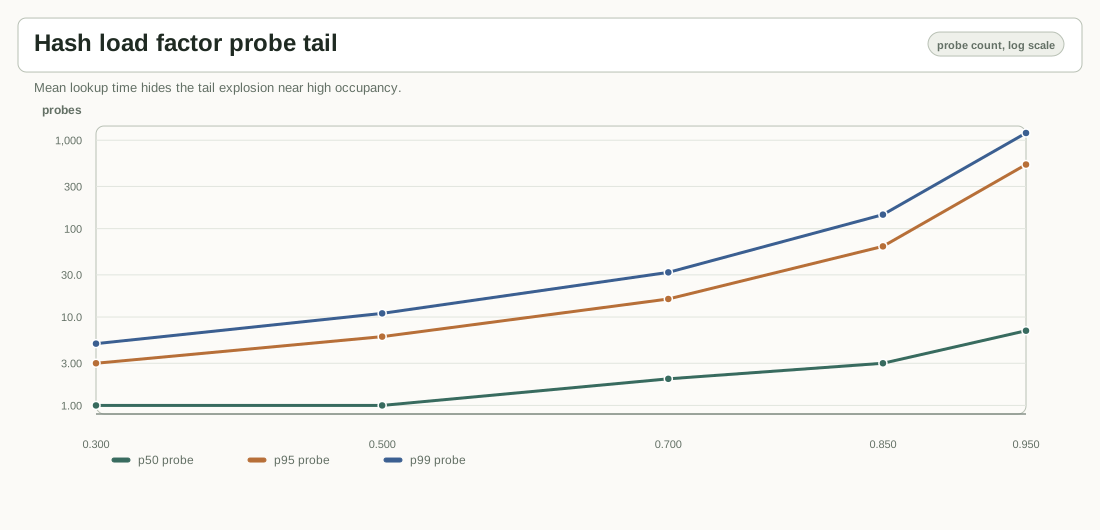
| What happened | Probe tails grew much faster than medians at high load. At 0.95 load, p99 probes exceeded 1200. |
| Takeaway | Hash tables need load-factor and tail-probe measurements, not only average lookup time. |
| Evidence status | Supported by timing and representative counters. |
Detailed rows
| Target load | Inserted keys | ns/query | p50 probes | p95 probes | p99 probes |
|---|---|---|---|---|---|
0.30 | 157,286 | 138.442 | 1 | 3 | 5 |
0.50 | 262,144 | 175.606 | 1 | 6 | 11 |
0.70 | 367,001 | 227.824 | 2 | 16 | 32 |
0.85 | 445,644 | 297.676 | 3 | 63 | 144 |
0.95 | 498,073 | 676.317 | 7 | 531 | 1207 |
| Event | Count |
|---|---|
| cycles | 725,366,509 |
| instructions | 1,174,526,099 |
| cache references | 10,805,729 |
| cache misses | 7,064,581 |
| LLC load misses | 6,815,291 |
| dTLB load misses | 2,542,337 |
| branches | 284,527,336 |
| branch misses | 9,065,424 |
8.4 Robin Hood Hashing
Code Shape
while (slotOccupied(i)) {
    if (table[i].key == key) {
        return true;
    }
    if (probeDistance(i) < currentProbeDistance) {
        return false;
    }
    i = (i + 1U) & mask;
}
Cache-Line Access Visual
CPU -> [? bucket]
       -> [CL: slot probe=0 | slot probe=1 | slot probe=2]

reference point:
local probes remain, but distance metadata controls tails
Interpretation
| Field | Notes |
|---|---|
| Expectation | Robin Hood should reduce probe-tail variance compared with basic linear probing. |
| Measured result | Robin Hood row: detailed rows below. |
| What happened | Robin Hood beat linear probing in the compare-all row and had low p99 probes in the tail row. |
| Takeaway | Probe-tail distribution is as important as mean lookup time. |
| Evidence status | Supported directionally. |
Detailed rows
| Variant | ns/query | p50 probes | p95 probes | p99 probes |
|---|---|---|---|---|
| Robin Hood | 134.260 | 1 | 3 | 5 |
| Variant | ns/query | Visual |
|---|---|---|
| Robin Hood | 95.566 | ############## |
| linear probing | 118.353 | ################## |
8.5 Bucketized Hash
Code Shape
Bucket& bucket = buckets[bucketIndex(key)];

for (int slot = 0; slot < BucketSize; ++slot) {
    if (bucket.occupied[slot] && bucket.keys[slot] == key) {
        return true;
    }
}
Cache-Line Access Visual
bucket size 4:
CPU -> [CL bucket: slot0 slot1 slot2 slot3]

bucket size 16:
CPU -> [CL bucket part A] [CL bucket part B] [CL bucket part C] ...

reference point:
one bucket access tests several candidates
Interpretation
| Field | Notes |
|---|---|
| Expectation | Bucket size should have a sweet spot: too small means more overflow, too large means too much local scan. |
| Measured result | Detailed rows below; benchmark numbers unchanged. |
| What happened | Bucket size 4 was best in this pass. |
| Takeaway | Bucket size is the hash-map version of block size: one memory access should buy enough comparisons, but not too many. |
| Evidence status | Supported by timing. |
Detailed rows
| Bucket size | ns/query | Visual |
|---|---|---|
4 | 91.262 | ########### |
8 | 120.048 | ############### |
16 | 164.193 | #################### |
8.6 Dense ID Array
Code Shape
int get(std::uint32_t denseId) {
    return values[denseId];
}
Cache-Line Access Visual
CPU -> [CL values: v0 v1 v2 v3 v4 v5 v6 v7]
       direct index

reference point:
hashing and collision handling are removed
Interpretation
| Field | Notes |
|---|---|
| Expectation | Dense IDs should be the upper-bound baseline when the key domain allows direct indexing. |
| Measured result | Detailed rows below; benchmark numbers unchanged. |
| What happened | Dense ID lookup was much cheaper than hash-table rows. |
| Takeaway | When possible, remove hashing from the hot path rather than optimizing it. |
| Evidence status | Supported by timing and byte accounting. |
Detailed rows
| Variant | ns/query |
|---|---|
| dense ID array | 11.384 |
| Variant | ns/query | Avg probes | p95 probes | Estimated bytes/lookup |
|---|---|---|---|---|
| dense ID array | 13.156 | 1.000 | 1 | 4.000 |
8.7 Tag Split Hash
Code Shape
auto tag = fingerprint(hash);
auto& meta = metadata[bucket];

for (int i = 0; i < 16; ++i) {
    if (meta.tags[i] == tag) {
        const Entry& entry = entries[meta.entryIndex[i]];
        if (entry.key == key) {
            return true;
        }
    }
}

return false;
Cache-Line Access Visual
CPU -> [CL tag metadata: t0 t1 t2 ... t15]
       tag mismatch -> stop
       tag match    -> [CL full entry: key value]

reference point:
metadata can reject many misses before loading payload
Interpretation
| Field | Notes |
|---|---|
| Expectation | Tag split should help misses and large-payload lookups, but tag width can trade false positives against metadata cost. |
| Measured result | Tag-size sweep: detailed rows below. |
| What happened | Tag width differences were small. Tag split did not win broadly at 0% hits, but helped in 50% and 100% rows in this implementation. |
| Takeaway | Fingerprint metadata needs hit/miss-ratio measurements. It is not automatically faster. |
| Evidence status | Partially supported. |
Detailed rows
| Tag bits | ns/query | p50 probes | p95 probes | p99 probes | Visual |
|---|---|---|---|---|---|
7 | 144.311 | 1 | 3 | 4 | ################### |
8 | 146.515 | 1 | 3 | 4 | ################### |
12 | 147.959 | 1 | 3 | 4 | #################### |
16 | 145.981 | 1 | 3 | 4 | ################### |
| Variant | Hit ratio | ns/query | p95 probes | p99 probes |
|---|---|---|---|---|
| linear | 0% | 161.529 | 8 | 13 |
| tag8 | 0% | 175.518 | 8 | 13 |
| tag16 | 0% | 170.531 | 8 | 13 |
| linear | 50% | 174.359 | 6 | 11 |
| tag8 | 50% | 160.616 | 6 | 11 |
| tag16 | 50% | 162.057 | 6 | 11 |
| linear | 100% | 117.693 | 4 | 7 |
| tag8 | 100% | 109.967 | 4 | 7 |
| tag16 | 100% | 106.242 | 4 | 7 |
8.8 Hot/Cold Hash
Code Shape
struct EntryHot {
    std::uint64_t key;
    std::uint32_t valueIndex;
    State state;
};

if (hot[i].key == key) {
    return values[hot[i].valueIndex];
}
Cache-Line Access Visual
normal entry:
CPU -> [CL: key state value payload payload]

split entry:
CPU -> [CL hot: key state valueIndex]
only on match -> [cold payload]

reference point:
payload stays cold during failed lookup
Interpretation
| Field | Notes |
|---|---|
| Expectation | Hot/cold split should help once value payload is large enough. |
| Measured result | Detailed rows below; benchmark numbers unchanged. |
| What happened | Split layout lost at 16 B and won for larger payloads. |
| Takeaway | Hot/cold split is conditional. It helps when payload is large and not always consumed. |
| Evidence status | Supported by timing. |
Detailed rows
| Payload | Normal entry ns/query | Split hot/cold ns/query |
|---|---|---|
16 B | 177.117 | 191.221 |
64 B | 211.278 | 181.337 |
128 B | 222.311 | 178.956 |
256 B | 236.144 | 184.487 |
8.9 Batched Prefetch Lookup
Code Shape
for (std::size_t i = 0; i < keys.size(); i += Batch) {
    for (std::size_t j = i; j < i + Batch; ++j) {
        bucket[j - i] = table.bucketIndex(keys[j]);
        prefetchRead(&table.entries[bucket[j - i]]);
    }

    for (std::size_t j = i; j < i + Batch; ++j) {
        found += table.findFromBucket(keys[j], bucket[j - i]);
    }
}
Cache-Line Access Visual
phase 1:
CPU computes bucket0 bucket1 bucket2 bucket3
P -> [CL bucket0] [CL bucket1] [CL bucket2] [CL bucket3]

phase 2:
CPU uses bucket0 bucket1 bucket2 bucket3

reference point:
batching creates independent future addresses
Interpretation
| Field | Notes |
|---|---|
| Expectation | Batching should expose memory-level parallelism. Too-large batches may add overhead or pollution. |
| Measured result | Single-thread: detailed rows below. |
| What happened | Batch 8 was best in the single-thread row. |
| Takeaway | Batching can improve lookup throughput, but batch size is workload-specific. |
| Evidence status | Supported by timing. |
Detailed rows
| Batch size | ns/query | Visual |
|---|---|---|
1 | 137.675 | #################### |
2 | 122.769 | ################## |
4 | 108.192 | ################ |
8 | 99.972 | ############### |
16 | 106.113 | ############### |
32 | 110.872 | ################ |
8.10 Set-Conflict Hash
Code Shape
std::size_t indexIdentity(std::uint64_t key) {
    return key & mask;
}

std::size_t indexMixed(std::uint64_t key) {
    return splitmix64(key) & mask;
}
Cache-Line Access Visual
identity + patterned keys:
CPU -> [CL set A] -> [CL set A] -> [CL set A] !

mixed hash:
CPU -> [CL set A] -> [CL set C] -> [CL set F]

reference point:
hash choice affects table placement and cache-set pressure
Interpretation
| Field | Notes |
|---|---|
| Expectation | Hash quality and table size should affect lookup time, especially with patterned keys. |
| Measured result | Sequential keys: detailed rows below. |
| What happened | Identity hashing was not worst on this sequential-key workload. |
| Takeaway | Conflict experiments must include realistic bad key patterns, not only sequential keys. |
| Evidence status | Partially supported. |
Detailed rows
| Table size | Hash | ns/query | Visual |
|---|---|---|---|
| 1,048,576 | identity | 36.584 | ########### |
| 1,048,576 | splitmix64 | 67.638 | ################### |
| 1,048,576 | multiplicative | 73.249 | #################### |
| 1,048,699 | identity | 36.638 | ########### |
| 1,048,699 | splitmix64 | 65.814 | ################## |
| 1,049,585 | identity | 35.920 | ########## |
| 1,049,585 | splitmix64 | 64.511 | ################## |
8.11 Tombstone Degradation
Code Shape
eraseSomeKeys();       // leaves tombstones
measureLookup();

rehashWithoutDeadSlots();
measureLookup();
Cache-Line Access Visual
before repair:
CPU -> [CL: filled tombstone filled tombstone empty]

after rehash:
CPU -> [CL: filled filled empty . .]

reference point:
tombstones extend probe chains
Interpretation
| Field | Notes |
|---|---|
| Expectation | Tombstones should degrade lookup by lengthening probe sequences. Rehash repair should reduce tails. |
| Measured result | Original benchmark status: detailed rows below. |
| What happened | Rehash repair reduced both time and probe tails. |
| Takeaway | Open-addressed hash tables must account for table aging, not just fresh construction. |
| Evidence status | Replacement measured; original benchmark blocked by correctness. |
Detailed rows
hashmap_tombstone_degradation: blocked by correctness| Variant | Tombstones | ns/query | p50 probes | p95 probes | p99 probes |
|---|---|---|---|---|---|
| with tombstones | 72,447 | 212.913 | 1 | 10 | 18 |
| rehashed | 0 | 156.024 | 1 | 6 | 11 |
8.12 Bytes Per Lookup
Code Shape
bytes += probes * bytesPerHotSlot;
if (keyMatch) {
    bytes += bytesPerPayload;
}
Cache-Line Access Visual
dense ID:
CPU -> [CL values: *]                 about 4 B useful payload

tag split:
CPU -> [CL tags: * * * *] -> maybe [full entry]

bucketized:
CPU -> [CL bucket with many slots]     more bytes per probe

reference point:
estimated bytes and timing may rank layouts differently
Interpretation
| Field | Notes |
|---|---|
| Expectation | Estimated bytes touched should explain part of lookup time but not all of it. |
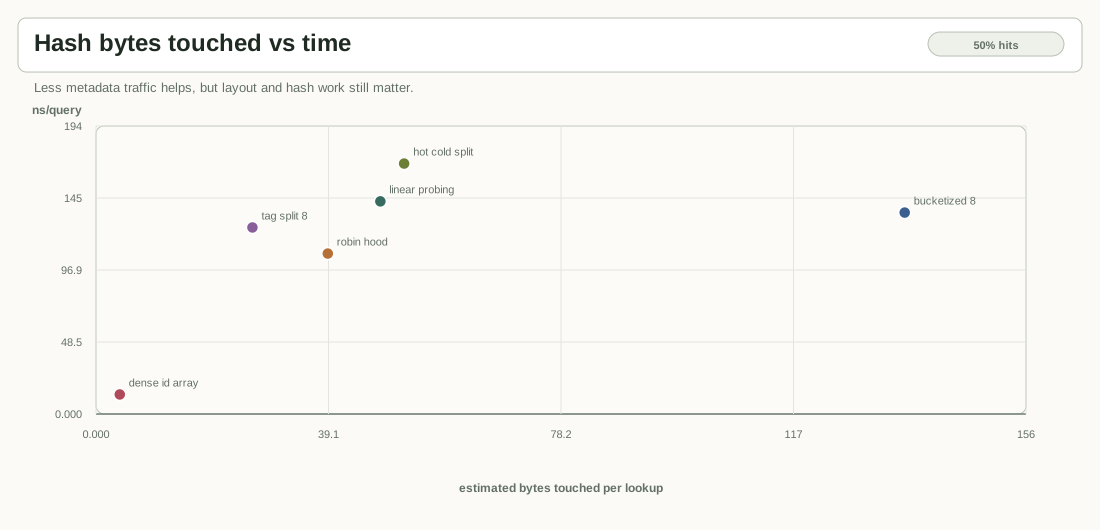
| Measured result | 50% hits: detailed rows below. |
| What happened | Dense ID touched the fewest bytes and was fastest. Bucketized had low probe count but high estimated bytes. |
| Takeaway | Probe count alone is incomplete. Bytes touched and cache-line footprint also matter. |
| Evidence status | Supported by software byte accounting and timing. |
Detailed rows
| Variant | ns/query | Avg probes | p95 probes | Estimated bytes/lookup |
|---|---|---|---|---|
| dense ID array | 13.156 | 1.000 | 1 | 4.000 |
| Robin Hood | 108.014 | 1.625 | 3 | 39.001 |
| tag split 8 | 125.573 | 1.277 | 3 | 26.323 |
| bucketized 8 | 135.593 | 1.001 | 1 | 136.074 |
| linear probing | 143.145 | 1.994 | 6 | 47.846 |
| hot/cold split | 168.590 | 1.994 | 6 | 51.846 |
9. Multithreaded Code Shapes
What changes when cache lines become ownership units shared across cores?9.1 False Sharing
Code Shape
for (std::uint64_t i = 0; i < steps; ++i) {
    counters[threadId].value++;
}
Cache-Line Access Visual
bad adjacent counters:
[CL0: T0 counter | T1 counter | T2 counter | T3 counter]
       ! ownership moves between cores on writes

reference point:
threads write different variables but share one cache line
Interpretation
| Field | Notes |
|---|---|
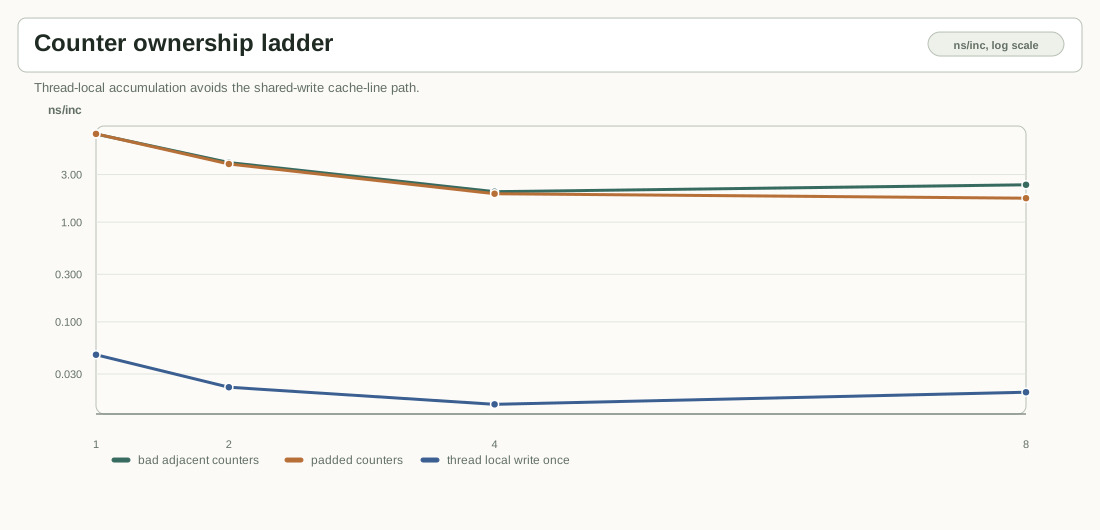
| Expectation | Adjacent counters should scale poorly because writes move cache-line ownership between cores. |
| Measured result | steps = 5,000,000, 3 repetitions: detailed rows below. |
| What happened | The adjacent row was worse than padded at 8 threads, but local write-once was much stronger than both. |
| Takeaway | Avoid repeated shared writes inside hot loops. |
| Evidence status | Supported by timing; perf c2c evidence is blocked by tooling. |
Detailed rows
| Threads | Bad adjacent ns/inc | Padded ns/inc | Local write-once ns/inc |
|---|---|---|---|
1 | 7.642 | 7.669 | 0.047 |
2 | 3.958 | 3.826 | 0.022 |
4 | 2.020 | 1.926 | 0.015 |
8 | 2.368 | 1.737 | 0.020 |
9.2 Padded Counters
Code Shape
struct alignas(64) PaddedCounter {
    std::uint64_t value = 0;
};

counters[threadId].value++;
Cache-Line Access Visual
padded counters:
[CL0: T0 counter]
[CL1: T1 counter]
[CL2: T2 counter]
[CL3: T3 counter]

reference point:
each writer owns a separate line
Interpretation
| Field | Notes |
|---|---|
| Expectation | Padding should reduce false sharing when threads repeatedly publish per-thread counters. |
| Measured result | 8-thread row: detailed rows below. |
| What happened | Padding improved the 8-thread counter row. |
| Takeaway | Padding is useful when repeated writes to result slots are unavoidable. |
| Evidence status | Supported by timing. |
Detailed rows
| Variant | ns/inc |
|---|---|
| bad adjacent counters | 2.368 |
| padded counters | 1.737 |
9.3 Local Write-Once Counters
Code Shape
std::uint64_t local = 0;

for (auto query : myQueries) {
    local += search(query);
}

results[threadId].value = local;
Cache-Line Access Visual
hot loop:
T0 -> register/local stack only
T1 -> register/local stack only

end:
T0 -> [CL result0]
T1 -> [CL result1]

reference point:
shared write happens once
Interpretation
| Field | Notes |
|---|---|
| Expectation | Local accumulation should beat both adjacent and padded counters when the computation can reduce at the end. |
| Measured result | 8-thread row: detailed rows below. |
| What happened | Local write-once was much cheaper than both shared-counter layouts. |
| Takeaway | Make reads shared and writes private. |
| Evidence status | Supported by timing. |
Detailed rows
| Variant | ns/inc |
|---|---|
| bad adjacent counters | 2.368 |
| padded counters | 1.737 |
| local write-once | 0.020 |
9.4 Read-Only Binary Search Scaling
Code Shape
std::size_t begin = threadId * queries.size() / threadCount;
std::size_t end = (threadId + 1U) * queries.size() / threadCount;

for (std::size_t i = begin; i < end; ++i) {
    local += contains(sharedIndex, queries[i]);
}
Cache-Line Access Visual
shared data:
all threads -> read-only [array/tree cache lines]

queries:
T0 -> query range 0
T1 -> query range 1
T2 -> query range 2

reference point:
shared reads, private counters
Interpretation
| Field | Notes |
|---|---|
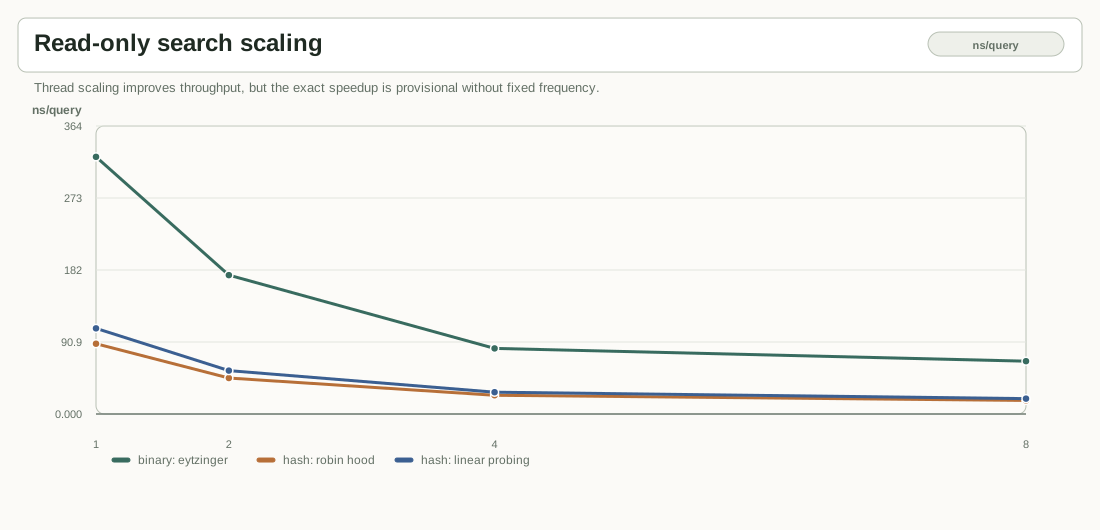
| Expectation | Read-only search should scale until memory latency, bandwidth, topology, or frequency effects dominate. |
| Measured result | n = 1,000,000, queries = 1,000,000, 3 repetitions: detailed rows below. |
| What happened | Eytzinger stayed the fastest 8-thread row. Some speedups were above ideal, so exact speedup values remain provisional. |
| Takeaway | Use these rows for direction, not as fixed-frequency scaling claims. |
| Evidence status | Supported directionally; fixed-frequency and SMT-off reruns are missing. |
Detailed rows
| Variant | 1 thread ns/query | 4 threads ns/query | 8 threads ns/query | 8-thread speedup |
|---|---|---|---|---|
| binary | 751.195 | 203.478 | 124.309 | 6.043x |
| branchless | 570.114 | 217.112 | 112.639 | 5.061x |
| Eytzinger | 324.589 | 82.790 | 66.675 | 4.868x |
| blocked | 493.224 | 124.722 | 84.513 | 5.836x |
9.5 Read-Only Hash Scaling
Code Shape
for (std::size_t i = begin; i < end; ++i) {
    local += table.find(queries[i]);
}

results[threadId].value = local;
Cache-Line Access Visual
T0 -> [? bucket] -> local probes
T1 -> [? bucket] -> local probes
T2 -> [? bucket] -> local probes

shared table is read-only
per-thread result is private or padded
Interpretation
| Field | Notes |
|---|---|
| Expectation | Read-only hash lookup should scale until memory resources saturate. |
| Measured result | n = 500,000, queries = 1,000,000, 3 repetitions: detailed rows below. |
| What happened | Robin Hood was the fastest 8-thread hash-layout row. |
| Takeaway | Threaded lookup should be measured per layout; single-thread ranking may not directly transfer. |
| Evidence status | Supported directionally. |
Detailed rows
| Variant | 1 thread ns/query | 4 threads ns/query | 8 threads ns/query | 8-thread speedup |
|---|---|---|---|---|
| linear probing | 108.105 | 27.522 | 19.392 | 5.575x |
| Robin Hood | 88.702 | 23.636 | 17.099 | 5.187x |
| bucketized 8 | 120.989 | 30.956 | 31.086 | 3.892x |
| tag split 8 | 79.193 | 21.796 | 20.722 | 3.822x |
| hot/cold split | 122.975 | 33.371 | 26.947 | 4.564x |
9.6 Chunked-List Scaling
Code Shape
std::size_t firstChunk = threadId * chunks.size() / threadCount;
std::size_t lastChunk = (threadId + 1U) * chunks.size() / threadCount;

for (std::size_t c = firstChunk; c < lastChunk; ++c) {
    scanChunk(chunks[c]);
}
Cache-Line Access Visual
T0 -> chunks [0..K/T)
T1 -> chunks [K/T..2K/T)
T2 -> chunks [2K/T..3K/T)

reference point:
threads scan disjoint ranges instead of all starting at the same head
Interpretation
| Field | Notes |
|---|---|
| Expectation | Chunk-range partitioning should scale better than all threads scanning from the same list head. |
| Measured result | n = 1,000,000, chunk size 64, 3 repetitions: detailed rows below. |
| What happened | Scaling improved through 4 threads and then got worse at 8 threads. |
| Takeaway | Partitioning avoids duplicate work, but memory throughput and scheduling still limit scaling. |
| Evidence status | Supported directionally. |
Detailed rows
| Threads | ns/value | Speedup | Efficiency |
|---|---|---|---|
1 | 1.228 | 1.000x | 1.000 |
2 | 0.708 | 1.734x | 0.867 |
4 | 0.501 | 2.453x | 0.613 |
8 | 0.950 | 1.293x | 0.162 |
9.7 Batched Hash Scaling
Code Shape
for (std::size_t i = begin; i < end; i += Batch) {
    prefetchBatch(i);
    local += lookupBatch(i);
}
Cache-Line Access Visual
inside each thread:
P -> [bucket0] [bucket1] [bucket2] [bucket3]
then lookup bucket0..bucket3

across threads:
T0 batch stream
T1 batch stream
T2 batch stream

reference point:
MLP inside a thread plus parallel query ranges
Interpretation
| Field | Notes |
|---|---|
| Expectation | Batching should improve lookup throughput, but the best batch size may change with thread count. |
| Measured result | n = 500,000, queries = 1,000,000, 3 repetitions: detailed rows below. |
| What happened | Batch 8 was best single-thread. Batch 4 was best at 8 threads. |
| Takeaway | Batch size is not constant across thread counts. |
| Evidence status | Supported by timing. |
Detailed rows
| Batch | 1 thread ns/query | 4 threads ns/query | 8 threads ns/query | 8-thread speedup |
|---|---|---|---|---|
1 | 137.084 | 48.877 | 37.931 | 3.614x |
2 | 118.550 | 32.283 | 21.828 | 5.431x |
4 | 104.851 | 27.642 | 19.576 | 5.356x |
8 | 97.752 | 37.052 | 27.606 | 3.541x |
16 | 105.205 | 27.144 | 19.794 | 5.315x |
32 | 107.414 | 28.266 | 20.231 | 5.309x |
9.8 Read-Only Stream Bandwidth
Code Shape
for (std::size_t i = begin; i < end; ++i) {
    local += values[i];
}
Cache-Line Access Visual
T0 -> [CL range 0: * * * *]
T1 -> [CL range 1: * * * *]
T2 -> [CL range 2: * * * *]
T3 -> [CL range 3: * * * *]

reference point:
disjoint read-only streaming ranges
Interpretation
| Field | Notes |
|---|---|
| Expectation | Stream bandwidth should rise with threads until memory bandwidth saturates. |
| Measured result | n = 8,388,608 uint64_t values, 5 repetitions: detailed rows below. |
| What happened | The stream row peaked at 4 threads and fell at 8 threads. |
| Takeaway | This gives a concrete bandwidth-saturation boundary for the measured setup. |
| Evidence status | Supported directionally; fixed-frequency rerun missing. |
Detailed rows
| Threads | ns/value | GB/s | Speedup | Efficiency |
|---|---|---|---|---|
1 | 1.333 | 6.000 | 1.000x | 1.000 |
2 | 0.735 | 10.886 | 1.814x | 0.907 |
4 | 0.473 | 16.903 | 2.817x | 0.704 |
8 | 0.519 | 15.413 | 2.569x | 0.321 |
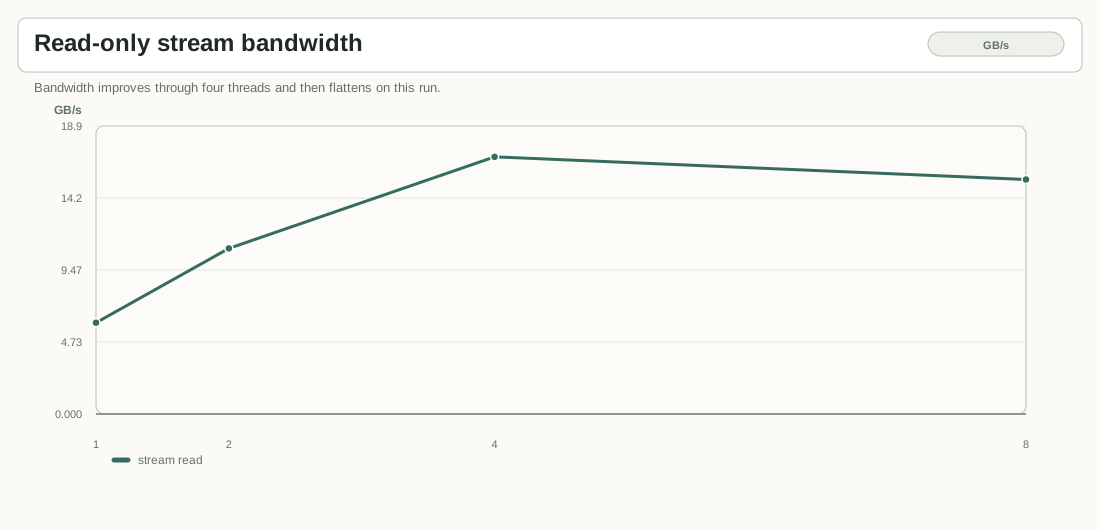
10. Result Map
| Topic | Best measured row in this pass | Main note |
|---|---|---|
| Linear scan | 64 MiB int32_t, 0.867 ns/element | baseline stream |
| Stride scan | 64 MiB stride 16, 10.034 ns/access | strided access wastes cache-line payload |
| Full raw working-set ladder | 64 MiB linear 0.867 ns/op, random 45.038, dependent 160.778 | all raw-memory families now have ladder rows |
| Huge page probe | default 4 KiB pages 1.289 ns/value; transparent huge page path 1.253; explicit huge pages unavailable | huge-page result is measured/probed |
| Associativity | stride 1025, 5.163 ns/access among listed conflict rows | plus-one strides were faster than paired power-of-two strides |
| Pointer chase | arena sequential, 5.845 ns/node | layout and order matter |
| Dependent chase | sequential cycle, 6.674 ns/step | random dependency costs about 14x |
| MLP chase | 16 lanes, 17.128 ns/chain-step | independent misses overlap |
| Linked list | chunked 64, 129,629 ns/query | chunking reduces pointer jumps |
| Linked-list mutation | indexed insert 13.728 ns/op; heap insert-new 177.696 ns/op | allocation and pointer rewrites dominate mutation |
| Hot/cold list | 256 B payload, 7.6x faster than fat node | keep payload cold |
| Binary search | Eytzinger, 328.340 ns/query | layout beats normal binary |
| Branch-miss counter row | binary-search program 11.60%; hash linear probing 3.19% | representative perf stat evidence exists |
| Query ordering | clustered binary, 80.564 ns/query | work order changes locality |
| Hash map | chained arena, 69.551 ns/query | measured winner in this implementation |
| Hash bytes touched | tag split 8 estimated 26.323 B/lookup at 50% hits | bytes and time rank layouts differently |
| Batched hash | batch 8 single-thread, 97.752 ns/query | batching improved MLP over batch 1 |
| False sharing | 8-thread adjacent counters, 2.368 ns/inc vs padded 1.737 vs local 0.020 | private accumulation is the cleanest shape |
| Binary scaling | Eytzinger 8 threads, 66.675 ns/query | fastest threaded binary-search row |
| Hash scaling | Robin Hood 8 threads, 17.099 ns/query | fastest threaded hash-layout row |
| Batched hash scaling | batch 4 at 8 threads, 19.576 ns/query | batching sweet spot changed with thread count |
| Stream bandwidth | 4 threads, 16.903 GB/s | bandwidth flattened after 4 threads |
11. Negative Results And Mixed Results
| Observation | Status | Interpretation |
|---|---|---|
| Simple linked-list prefetch did not rescue pointer chasing. | Mixed | The future address is discovered too late for prefetch to hide much latency. |
| Arena allocation did not fix random traversal. | Supported | Contiguous storage is not enough when traversal order is random. |
| Chained arena beat the expected open-addressing winner in one hash compare-all row. | Mixed | Implementation details and compact chains mattered on this system. |
| Transparent huge-page advice had a small measured delta. | Inconclusive | Explicit huge pages were unavailable, so the result is not a full huge-page claim. |
| Padding counters helped, but local accumulation was much better. | Supported | Avoiding repeated shared writes is stronger than spacing them out. |
| Tombstone degradation original binary failed correctness. | Blocked by correctness | Replacement rows are useful, but the original benchmark cannot support timing claims. |
perf c2c was unavailable. | Blocked by tooling | False-sharing claims are timing-backed, not c2c/HITM-backed. |
12. Tradeoff Matrix
| Optimization | Helps when | Hurts when | Evidence strength |
|---|---|---|---|
| Sequential layout | Traversal order is known. | Queries require random access. | Supported |
| Chunked list | Read-heavy misses or late hits dominate. | Mutation inside chunks is frequent. | Supported |
| Hot/cold split | Search touches metadata more than payload. | Every lookup consumes payload immediately. | Supported |
| Bloom chunk filter | Negative lookups dominate. | Hit-heavy lookup pays filter overhead. | Partially supported |
| Branchless binary | Branch mispredicts are material. | Memory stalls dominate. | Partially supported |
| Blocked search | One global jump can be traded for local scans. | Block scans become too large. | Partially supported |
| Eytzinger layout | Static large arrays are searched repeatedly. | Frequent updates require rebuilds. | Supported |
| Robin Hood hashing | Probe-tail control matters. | Insert displacement cost matters. | Partially supported |
| Tag split hash | Misses and large payloads are common. | Tags false-positive often or payloads are small. | Partially supported |
| Batched lookup | Independent queries exist. | Single-query latency is the target. | Supported directionally |
| Padded counters | Threads must publish per-thread counters. | Local accumulation can write once. | Supported |
13. Research Claims
| Claim | Mechanism | Measurement evidence | Caveat | Verdict |
|---|---|---|---|---|
| Sequential scan is the baseline to beat. | Full cache-line use and predictable access. | Linear scan and working-set rows. | Absolute timings are system-specific. | Supported |
| Pointer chasing is slow because the next address is data-dependent. | Load-to-use dependency prevents overlap. | Dependent chase and linked-list rows. | Arena allocation helps compact cases. | Supported |
| Chunking improves list search. | One pointer jump covers many local comparisons. | Chunked list and hit-position rows. | Mutation cost changes the tradeoff. | Supported |
| Binary-search layout can matter as much as comparison count. | Fewer global jumps or better tree layout. | Eytzinger, blocked, and fanout rows. | No layout wins every row. | Supported |
| Hash-map lookup quality depends on collision layout and metadata placement. | Local probes, probe tails, hot metadata. | Compare-all, probe-tail, tag, hot/cold, and byte rows. | Chained arena beat expectations in one row. | Supported |
| Batching can expose memory-level parallelism. | Independent bucket or chain requests overlap. | MLP and batched hash rows. | Batch sweet spot depends on workload and thread count. | Supported directionally |
| False sharing can distort benchmark results. | Cache-line ownership transfers on adjacent writes. | Adjacent, padded, and local counter rows. | perf c2c unavailable. | Partially supported |
14. Remaining Evidence
| Topic | Status | Needed next |
|---|---|---|
| Per-variant branch counters | partially measured | Isolate normal binary, branchless, Eytzinger, and blocked binaries under separate perf stat runs. |
| Direct RFO/HITM evidence | blocked by tooling | Requires CPU-specific events or available perf c2c. |
| SMT-off scaling | not measured yet | Rerun threaded rows with sibling threads disabled. |
| Fixed-frequency scaling | not measured yet | Rerun with frequency pinned where permissions and hardware allow. |
| Cross-machine validation | not measured yet | Repeat on at least one newer CPU and one different cache hierarchy. |
| Production hash variants | not measured yet | Add string keys, realistic deletion churn, and production-style allocators. |
15. Reproducibility Notes
| Item | Public description |
|---|---|
| Measurement run | Benchmark suite run on 2026-06-02 |
| Benchmark code | Scalar C++20, no SIMD or assembly in this version |
| Build shape | 60 separate benchmark binaries |
| Timing method | Warmup, repeated runs, median timing, checksum-protected loops |
| Pinning | Single-thread rows pinned to one CPU; multithread rows pinned to the available CPU set |
| Counter rows | Representative Linux perf stat rows for binary search and hash-map lookup |
| Blocked tooling | perf c2c unavailable, so false sharing is not backed by c2c counter evidence |
| Invalid row policy | Correctness failures are reported as blocked and are not used for timing claims |
| Figure | What it shows |
|---|---|
| Working-set ladder | Raw-memory footprint effects |
| Prefetch distance | Stride prefetch-distance sweep |
| Linked-list miss cost | Linked-list miss cost and bytes per key |
| Binary locality sweep | Blocked search and implicit B-tree fanout |
| Hash probe tails | Load factor versus p50/p95/p99 probe tails |
| Hash bytes touched | Estimated bytes touched versus timing |
| Read-only search scaling | Threaded binary and hash lookup |
| Counter ownership ladder | Adjacent, padded, and local counter writes |
| Stream bandwidth | Read-only stream bandwidth scaling |
16. Limitations
| Area | Limitation |
|---|---|
| System coverage | One measured Linux x86_64 system is included in the current result tables. |
| CPU controls | SMT stayed enabled; frequency was not pinned; governor was powersave. |
| Counter coverage | Linux perf stat branch/cache rows exist for representative binary-search and hash-map binaries; perf c2c was unavailable. |
| Portability | Absolute timings are machine-specific; relative trends are the intended claim. |
| Implementation scope | Scalar C++20 only; no SIMD, assembly, cloud, or distributed-system mapping. |
| Data structures | Some implementations are first-pass benchmark structures, not production containers. |
| Completeness | The remaining missing items are mainly controlled-system counter reruns, SMT/frequency controls, and cross-machine validation. |
17. Final Takeaway
one value per pointer
-> many values per pointer

global jumps
-> local block scans

pointer chains
-> local probes

fat objects
-> hot metadata plus cold payload

one dependent miss
-> many independent misses

shared writes
-> private or padded writesPrimary references